Alternative Medicine vs Conventional Medicine vs Integrative Medicine: Which Is Right for You?
Explore alternative, integrative, and conventional medicine. Understand differences, benefits, risks and discover when integrative care may offer balanced, holistic healing.
Choosing the right approach to healthcare can feel confusing, especially when terms like alternative medicine, integrative medicine, and conventional medicine are used interchangeably. Each represents a very different philosophy of healing, yet most people are unsure where the lines are drawn.
This article aims to clarify the differences, highlight benefits and caveats, and guide readers on when a blended, integrative approach might be the most balanced path.
What Are Alternative, Conventional, and Integrative Medicine
Conventional (Mainstream / Western / Allopathic) Medicine
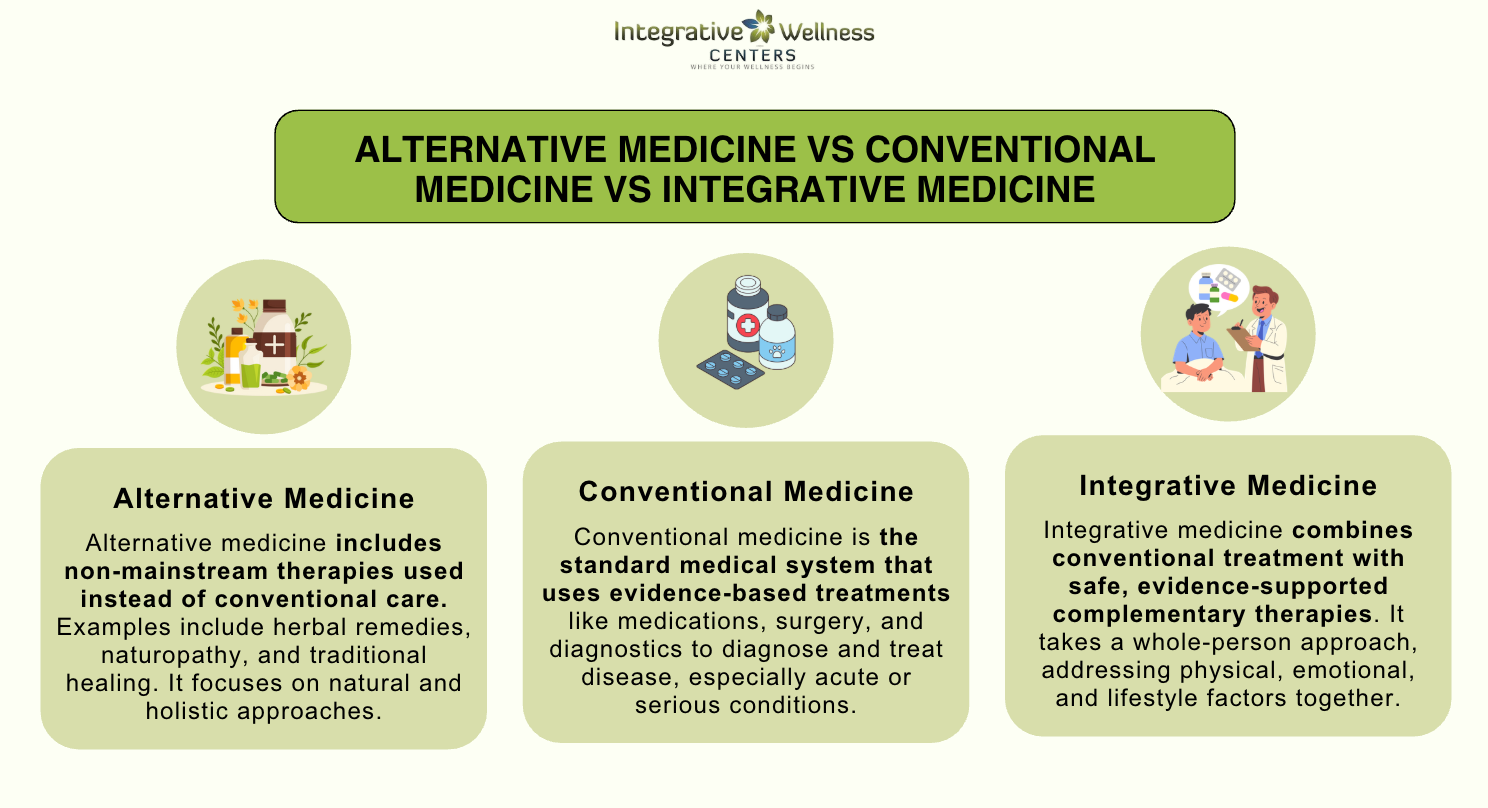
Conventional medicine refers to the standard healthcare system practiced by medical doctors, nurses, and allied professionals. relying on scientific research, evidence-based treatments, pharmaceuticals, surgery, radiation, and other interventions.
Its aim is often the diagnosis, treatment, and prevention of disease, especially acute illnesses, injuries, infections, and conditions requiring immediate or aggressive intervention.
Alternative Medicine
Alternative medicine refers to health practices and therapies that lie outside the realm of mainstream Western medicine. These are used instead of conventional treatments. Examples include herbal medicine, naturopathy, homeopathy, certain traditional systems, and various holistic practices.
Alternative medicine often emphasizes natural healing, the body’s innate ability to self-heal, and traditional or cultural health wisdom rather than relying solely on pharmaceuticals or invasive procedures.
Integrative Medicine
Integrative medicine (also sometimes referred to as “integrative and complementary medicine”) aims to combine the best of both worlds: conventional medicine and evidence-supported alternative or complementary practices. It’s a holistic, person-centered approach to health that considers not only physical symptoms, but mental, emotional, and lifestyle factors too.
Rather than rejecting conventional medicine or embracing alternative medicine exclusively, integrative medicine uses what’s appropriate, tailoring care to each individual in partnership with the patient.
Comprehensive care: disease treatment, prevention, wellness, lifestyle, emotional and mental health
Typical Use Cases
Acute illness, emergencies, defined medical conditions, surgery, serious disease
Chronic pain, mild chronic conditions, wellness, prevention, natural/holistic living
Chronic diseases, lifestyle-related conditions, chronic stress, integrative cancer care support, long-term wellness
Because of these differences, many experts and patients view integrative medicine as a balanced middle ground, embracing the strengths of both conventional and alternative approaches.
Why People Turn to Alternative or Integrative Medicine
Holistic desire for wellness: Many feel conventional medicine can be too symptom-focused and want care that treats “the whole person.” Integrative approaches consider nutrition, stress, sleep, emotional health, environment, and lifestyle.
Prevention and quality of life focus: Rather than waiting to get sick, many seek to maintain health, vitality, and prevent disease through balanced, integrative care.
Cultural, traditional or personal beliefs: Some individuals prefer therapies grounded in traditional medicine or natural healing, often passed down through generations.
Reducing reliance on pharmaceuticals: Avoiding or minimizing the use of long-term medication or invasive procedures by combining lifestyle, natural therapies, and conventional guidance.
Conventional Medicine: A person with acute appendicitis receives diagnosis via imaging and lab tests, then undergoes surgical removal of the appendix.
Alternative Medicine (used alone): Another person with the same pain opts for herbal remedies or “natural healing” instead of surgery or medical evaluation.
Integrative Medicine: A patient with chronic irritable bowel syndrome works with a clinician who combines diet and lifestyle modifications, stress management (e.g., mindfulness), perhaps herbal or probiotic support, along with conventional diagnostics and medications if needed.
Similarly, someone managing chronic autoimmune issues may benefit from integrative care by combining conventional immunomodulating therapy (if indicated) plus lifestyle, diet, stress reduction, and monitoring giving a more balanced path toward long-term wellness.
When Integrative Medicine Makes Sense
You might strongly consider integrative medicine if:
You’re dealing with chronic, complex, or multifactorial conditions (e.g., digestive issues, hormonal imbalance, autoimmune conditions, chronic pain, long-term stress) where conventional medicine alone may not address root causes.
You value a holistic, person-centered approach not just treating disease, but nurturing overall wellness: body, mind, lifestyle, environment.
You want preventive care and long-term quality of life, not just symptom management.
You prefer personalized care, with a care team willing to integrate lifestyle interventions, nutrition, mental health, and conventional treatments as needed.
Variable evidence base: Many alternative therapies lack robust scientific studies. Some rely on tradition or anecdotal results rather than rigorous clinical trials.
Potential for harmful interactions: Natural supplements or herbal remedies may interact with conventional medications or have side effects. Without proper oversight, risks increase.
Delay of necessary conventional treatments: For serious or acute illnesses, such as infections, cancers, or emergencies, relying solely on alternative medicine may result in delayed or inadequate care.
Quality and regulation issues: In some regions, alternative or traditional practices may not be standardized, regulated, or conducted by trained professionals. This raises concerns about safety, quality control, and legitimacy.
Because of these factors, many experts advocate for evidence-informed integrative medicine combining what is proven, safe, and effective with a holistic perspective, rather than rejecting one side wholesale.
Which Approach Should You Choose?
There’s no one-size-fits-all answer. The right approach depends on your health needs, values, lifestyle, and goals. Here’s a rough guideline:
If you face an acute illness, injury, infection, or serious condition: conventional medicine is often the safest, evidence-backed choice.
If you’re looking for overall wellness, prevention, lifestyle support, or managing chronic conditions: an integrative approach may offer the balanced, long-term care you need.
If considering alternative therapies alone: be cautious: ensure there’s at least some credible evidence, consult medical professionals, and don’t replace necessary conventional treatment, especially for serious issues.
If you’d like a balanced, evidence-informed, holistic plan tailored to your needs, then integrative medicine may be the best path forward.
Why More People Are Turning to Integrative Medicine Today
Growing patient demand for personalized, whole-person care. People increasingly want more than pills, they want lifestyle, nutrition, stress management, mental health, and long-term well-being.
Chronic diseases and lifestyle-related illnesses on the rise. As more people face diabetes, autoimmunity, hormonal issues, digestive disorders, stress-related conditions a multi-faceted approach often yields better outcomes.
Scientific interest in complementary therapies. While not all alternative practices have robust data, many are being studied with growing interest. As evidence-based CAM (Complementary and Alternative Medicine) evolves, integrative medicine offers a bridge.
Holistic health philosophy aligning with modern wellness demands. Health is no longer just absence of disease — it is about resilience, balance, vitality, mental clarity, and quality of life. Integrative medicine resonates with that broader definition of health.
For anyone seeking a compassionate, comprehensive approach to health, integrating science, lifestyle, prevention, and holistic well-being, integrative medicine offers a promising path.
Choosing between alternative, integrative, and conventional medicine ultimately comes down to what you need most from a quick symptom relief, natural healing, long-term wellness, or a balanced blend of all three. For many people, integrative and functional medicine provide the middle ground they’ve been searching for: care that is evidence-informed, personalized, and focused on restoring whole-body health.
What is the difference between conventional medicine and integrative medicine? Conventional medicine relies primarily on scientifically validated treatments (drugs, surgery, diagnostics). Integrative medicine blends those with complementary practices (when supported) to address the whole person: body, mind, lifestyle.
What is the major difference between the integrative and conventional approaches? The major difference lies in philosophy and scope: conventional treats disease; integrative treats the person, aiming for balance, prevention, and long-term wellness, beyond symptom management.
Which is better: integrative or functional medicine? “Functional medicine” is often considered a branch or rebranding within the integrative/alternative spectrum. Whether one is “better” depends on your needs: integrative typically combines conventional + complementary care; functional medicine may emphasize more root-cause and system-based approaches.
What are examples of integrative medicine? Integrative care could include conventional treatments (medications, diagnostics) paired with nutrition counseling, stress management, acupuncture, physical therapy, lifestyle changes, depending on evidence and patient needs.
Is integrative medicine the same as holistic medicine? They overlap considerably. Integrative medicine is often described as a form of holistic medicine, because it treats the whole person (body, mind, lifestyle, environment).
What are examples of conventional medicine? Conventional medicine includes prescription drugs, surgeries, radiation therapy, diagnostic tests, preventive immunization, transplant operations, emergency medicine, and more.
What is the core principle of integrative medicine? The core principle is to combine all appropriate therapeutic approaches, conventional and complementary, in a coordinated, evidence-informed way while focusing on the whole person, prevention, patient-practitioner partnership, and long-term wellness.
Why do people choose alternative medicine? People choose alternative medicine for various reasons: desire for natural or traditional healing, cultural or spiritual beliefs, dissatisfaction with side effects of mainstream drugs, chronic issues not well addressed by conventional care, or a wish for holistic wellness and prevention.
Is integrative medicine a doctor / are practitioners legitimate medical professionals? Integrative medicine is often practiced by licensed medical doctors (MDs or DOs) who have training or certification in integrative modalities. It sometimes also involves nutritionists, therapists, or complementary-medicine practitioners, but for safety and legitimacy, it's important they are properly credentialed and coordinate care.
Learn what a functional medicine nutritionist does, how lab-guided nutrition addresses root causes, and how to work with one in Michigan or via Zoom in most US states.
Fatigue, cramps, anxiety, poor sleep? Magnesium deficiency symptoms often hide behind normal labs. Learn why doctors miss it and how functional medicine finds the root cause.
Searching for a nutritionist in Livonia? Integrative Wellness Centers builds personalized nutrition plans on advanced lab testing to address root causes. Book a consultation.