
Learn how the anti-inflammatory diet works, which foods to eat and avoid, and how functional medicine lab testing personalizes it to address the root causes of your symptoms.
If you live with nagging joint pain, brain fog, digestive discomfort, skin flare-ups, or fatigue that never fully lifts, you have probably heard someone mention the anti-inflammatory diet. Maybe you have already tried cutting out a food or two, only to feel unsure whether it made any real difference. Many of the patients we work with arrive after years of being told their labs look normal, or after bouncing between specialists who each addressed one symptom without ever asking what all of those symptoms might have in common. Chronic inflammation is often that common thread, and food is one of the most powerful levers you have to influence it.
This guide walks through what an anti-inflammatory diet actually is, why generic advice so often falls short, which foods deserve a regular place on your plate, and which ones quietly work against you. We will also cover how a functional medicine approach uses lab testing to personalize anti-inflammatory eating rather than guessing. At Integrative Wellness Centers, this root-cause perspective has shaped how we support patients with inflammatory symptoms since 2012.
If you have been researching the anti-inflammatory diet because something in your body feels off and no one has explained why, you are not alone. Integrative Wellness Centers works with patients in-person across Michigan and via Zoom in most US states to identify what is actually driving inflammatory symptoms. You can schedule a new patient consultation to discuss your specific situation with our care team.
Inflammation itself is not the enemy. Short bursts of it are how your immune system fights infections and repairs injuries. The problem starts when the inflammatory response never fully switches off. Chronic, low-grade inflammation has been linked to many of the most common long-term health conditions, including cardiovascular disease, type 2 diabetes, autoimmune conditions, digestive disorders, and cognitive decline.
What makes chronic inflammation especially frustrating is how quietly it operates. It rarely announces itself with a single dramatic symptom. Instead, it shows up as persistent fatigue, achy joints, stubborn weight, mood changes, skin issues, or gut trouble that comes and goes. Because those symptoms are vague, they are easy to dismiss or to chalk up to stress and aging. Addressing the inflammation underneath them, rather than managing each symptom in isolation, is where meaningful change usually begins.
An anti-inflammatory diet is not a single branded meal plan. It is a style of eating that emphasizes whole, nutrient-dense foods known to help calm inflammatory pathways while limiting foods that tend to activate them. As Cleveland Clinic dietitians explain, the term refers to an overall eating pattern rather than a strict regimen, and well-studied patterns like the Mediterranean diet and the DASH diet both fit under this umbrella.
In practical terms, that means building most meals from vegetables, fruits, whole grains, legumes, fish, nuts, seeds, olive oil, herbs, and spices. It also means keeping ultra-processed foods, added sugars, refined flours, and processed meats to a minimum. No single food changes inflammation overnight. It is the cumulative pattern, repeated day after day, that gradually shifts inflammatory markers and how you feel.
Most people who ask their doctor about inflammation receive reasonable but generic advice: eat healthier, exercise, lose some weight. The advice is not wrong, it is just incomplete. A seven-minute appointment leaves no room to explore why your inflammation exists in the first place, and standard lab panels often stop at a basic CRP test, if inflammation gets measured at all.
There is also the question of lab interpretation. Conventional reference ranges are built to flag disease, not to define where the body functions best. A high-sensitivity CRP of 2.8 mg/L may be labeled acceptable even though it sits in a range associated with elevated cardiovascular risk. Research supports the dietary side of this picture as well. A comprehensive review of anti-inflammatory diets published through the National Library of Medicine found that eating patterns rich in fiber, omega-3 fatty acids, and polyphenols can meaningfully lower inflammatory markers and improve outcomes across several chronic conditions. Yet that nuance rarely makes it into a rushed office visit, which is why so many patients are left guessing about which foods matter for them personally.
Food is a major driver of inflammation, but it rarely acts alone. In our experience working with patients since 2012, chronic inflammation usually has several overlapping sources, and the diet works best when the other drivers are identified and addressed alongside it.
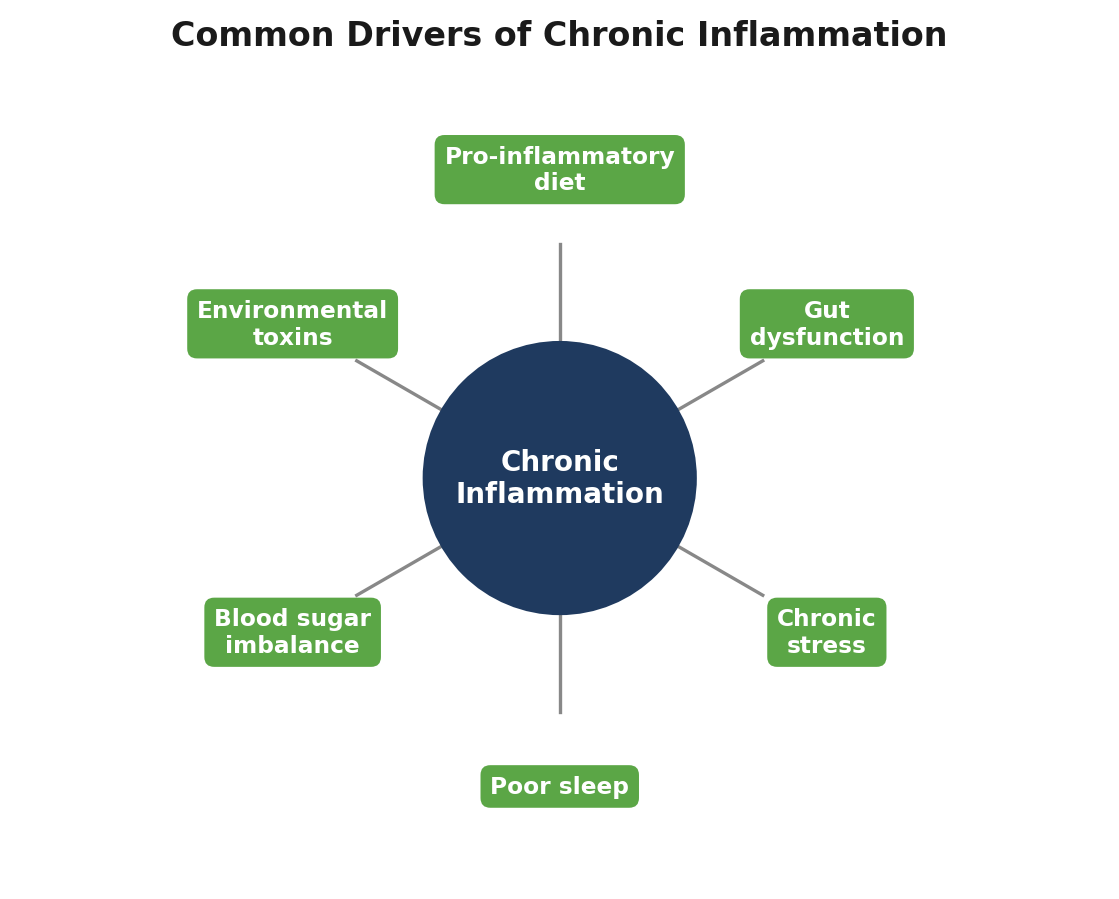
This is one reason inflammatory symptoms so often cluster together, and why conditions like autoimmune conditions tend to improve most when nutrition is combined with a broader root-cause workup.
The foundation of anti-inflammatory eating is abundance, not restriction. Harvard Health researchers point to green leafy vegetables, berries, fatty fish, nuts, olive oil, and whole grains as the core foods consistently associated with lower inflammatory activity. Here is how to put them to work.
Aim for a wide range of colors across the week. Deeply pigmented produce like berries, cherries, leafy greens, beets, and tomatoes is rich in polyphenols and antioxidants, plant compounds that help neutralize the free radicals involved in inflammatory damage. A practical target for most people is at least five servings of fruits and vegetables per day, with vegetables making up the majority.
Omega-3 fatty acids are among the best-studied dietary tools for calming inflammation. Fatty fish such as salmon, sardines, mackerel, and anchovies two or more times per week is the simplest way to get them. On the plant side, walnuts, flaxseeds, and chia seeds contribute additional omega-3s, while extra virgin olive oil and avocados supply anti-inflammatory monounsaturated fats that work well as everyday cooking and dressing fats.
Fiber from whole grains like oats, barley, quinoa, and brown rice, along with beans and lentils, feeds the beneficial gut bacteria that help regulate immune activity. Herbs and spices deserve more credit than they usually get. Turmeric, ginger, garlic, rosemary, and cinnamon each contain compounds with documented anti-inflammatory activity, and they make whole-food cooking far more enjoyable, which matters for consistency.
Just as important as what you add is what you scale back. According to Harvard Health’s quick-start guidance on anti-inflammatory eating, ultra-processed foods and added sweeteners are the biggest offenders, and refined flours push the body toward a pro-inflammatory state. The most common culprits include:
You do not need perfection. Most patients see the biggest change from consistently displacing these foods with the whole-food options above, rather than from white-knuckle elimination.
Generic food lists are a good starting point, but they cannot tell you why your inflammation exists or which changes will move the needle for your body. That is where a functional medicine workup differs from a printout handed to you at the end of a visit.
Instead of stopping at a basic panel, advanced lab testing can measure inflammatory markers like high-sensitivity CRP and homocysteine, assess blood sugar regulation with fasting insulin and HbA1c, evaluate gut health, screen for nutrient deficiencies, and check autoimmune markers where symptoms warrant it. Results are read against optimal ranges, not just disease-detection ranges, which often explains why someone feels unwell despite normal labs.
Testing turns the anti-inflammatory diet from a template into a targeted plan. One patient may need to focus on blood sugar stability, another on rebuilding gut bacteria, another on identifying specific food sensitivities that keep the immune system activated. Personalization also makes the plan sustainable, because you are only removing foods that matter for you rather than everything a generic list warns about.
Because stress, sleep, and movement influence inflammation as strongly as food does, a complete plan addresses them together. Progress is then tracked with follow-up labs and symptom reviews, so the plan can be adjusted based on evidence rather than guesswork. Testing, not guessing, is the principle that runs through every step.
Understanding what is driving your inflammation starts with the right testing and a care team that takes the time to listen. Integrative Wellness Centers offers in-person care across Michigan and Zoom consultations for patients in most US states. If you are ready to stop guessing and start getting answers, you can book a consultation with our functional medicine team.
Anti-inflammatory eating is not a quick fix, and anyone promising overnight results is overselling. Many patients notice early wins like steadier energy, less bloating, or calmer joints within the first several weeks. Deeper shifts, including measurable changes in inflammatory markers, typically unfold over a few months of consistent eating, which is why our care plans usually run 4 to 7 months with regular check-ins along the way.
The encouraging part is that the body is designed to move toward balance when it is given the right support. Patients often describe the change less as a dramatic turnaround and more as a gradual return of things they had stopped expecting: waking up rested, getting through the afternoon without crashing, or realizing a flare-up that used to be monthly has not appeared in a while.
These are the questions patients and readers ask most often about anti-inflammatory eating. Short answers are below, and your own plan should always be tailored to your labs and health history.
1. How long does it take for an anti-inflammatory diet to work?
Many people notice improvements in energy, digestion, or joint comfort within a few weeks of consistent changes. Measurable shifts in inflammatory lab markers usually take longer, often two to three months or more, which is why follow-up testing matters.
2. Is the Mediterranean diet the same as an anti-inflammatory diet?
They overlap heavily but are not identical. The Mediterranean diet is one well-researched example of an anti-inflammatory eating pattern, alongside approaches like the DASH diet. Anti-inflammatory eating is the broader principle, and it can be personalized beyond any named plan.
3. What are the worst foods for inflammation?
The most consistent offenders are added sugars, refined carbohydrates, processed meats, fried foods, and excess alcohol. Individual triggers vary, though, and some people react to foods that are neutral for others, which is where testing and structured elimination can help.
4. Do I need to cut out gluten and dairy completely?
Not necessarily. Some people genuinely react to gluten or dairy and feel significantly better without them, while others tolerate both well. Rather than eliminating food groups indefinitely on principle, it is more useful to identify whether they are actually a problem for you.
5. Can an anti-inflammatory diet help with autoimmune conditions?
Diet can be a meaningful part of supporting the body in autoimmune conditions, since food influences gut health and immune signaling. It works best as one component of a broader plan that also addresses gut function, nutrients, stress, and any underlying triggers, guided by a qualified provider.
6. How do I know if I have chronic inflammation?
Common signs include ongoing fatigue, joint or muscle aches, digestive issues, skin problems, and brain fog, but symptoms alone cannot confirm it. Lab markers such as high-sensitivity CRP, evaluated against optimal ranges, give a much clearer picture of where you stand.
If this article resonated with what you have been experiencing, the next step is finding out what is actually driving your symptoms. Integrative Wellness Centers has supported thousands of patients since 2012, both in-person across Michigan and via Zoom in most US states. Request a new patient consultation to start the conversation with our care team.
Medical Disclaimer: This article is for informational and educational purposes only. It is not intended as medical advice and should not replace consultation with a qualified healthcare provider. Integrative Wellness Centers makes no claims to diagnose, treat, cure, or prevent any disease. Always consult your doctor before making changes to your health regimen or discontinuing any medication.

Take the online digestive evaluation to instantly discover what systems of your body are the cause of your health issues.
Online Digestive EvaluationTake the TestOnline Female Hormone EvaluationOnline Male Hormone Evaluation


