
At-home hormone tests are convenient, but accuracy depends on timing and interpretation. Learn how they work, their limits, and when to get clinical testing.
If you have felt exhausted, foggy, moody, or just not like yourself, and a quick internet search led you to at-home hormone tests, you are far from alone. These kits promise answers you can get from your kitchen table, without a doctor visit, an insurance battle, or a lab waiting room. When you have spent months being told your labs look "normal" while you still feel awful, the appeal of taking testing into your own hands is easy to understand.
At-home hormone tests can be a useful starting point, but they come with real limits that matter for your health decisions. This article explains how these tests actually work, what they can and cannot tell you, where finger-prick, saliva, and dried urine methods differ, and when a single kit result deserves a second look from a clinician. At Integrative Wellness Centers, we take a root-cause approach that treats testing as one piece of a larger picture, not the whole answer.
If you have been searching for answers about your hormones and feel like generic testing has not addressed what is actually driving your symptoms, you do not have to sort it out alone. Integrative Wellness Centers works with patients in-person across Michigan and via Zoom in most US states to interpret hormone results in the context of your full health history. You can schedule a new patient consultation to talk through your specific situation with our care team.
Interest in at-home hormone testing has grown quickly, and the search data shows it. Terms like "at home hormone tests" draw thousands of searches every month, alongside related questions such as "are at home hormone tests accurate" and "how accurate are at home hormone tests." People are not just curious. They are frustrated, proactive, and looking for a way to understand what is happening inside their bodies.
That instinct is a good one. Hormones influence energy, sleep, mood, weight, libido, skin, menstrual cycles, and much more. When they drift out of balance, the effects ripple through daily life. The challenge is that a test result only helps if it is accurate, well-timed, and interpreted correctly. A number without context can send you down the wrong path, either falsely reassuring you or prompting worry over a result that was never reliable in the first place. Understanding both the value and the ceiling of at-home testing is what turns a kit from a gimmick into a genuinely useful tool.
At-home hormone tests are kits that let you collect a biological sample yourself, usually blood from a finger prick, saliva, or urine, and mail it to a laboratory for analysis. A few days later you receive results, often through an app or online portal, comparing your levels against a standard reference range. Common panels look at sex hormones such as estradiol, progesterone, and testosterone, the stress hormone cortisol, thyroid markers like TSH, and reproductive hormones such as FSH and LH.
The science underneath is real. Many hormones can be measured reliably outside a clinic. Saliva, for example, offers a noninvasive way to assess the free, biologically active fraction of certain steroid hormones, and research has shown it can be reliable and in some cases even preferable to blood for specific markers. Blood spot and urine methods each have their own strengths. The key point is that the sample type, the timing, and the laboratory quality all shape how trustworthy your result will be. For a plain-language overview of when hormone testing is appropriate, the Cleveland Clinic explains how doctors decide whether you need hormone testing by breaking symptoms down individually rather than lumping them together.

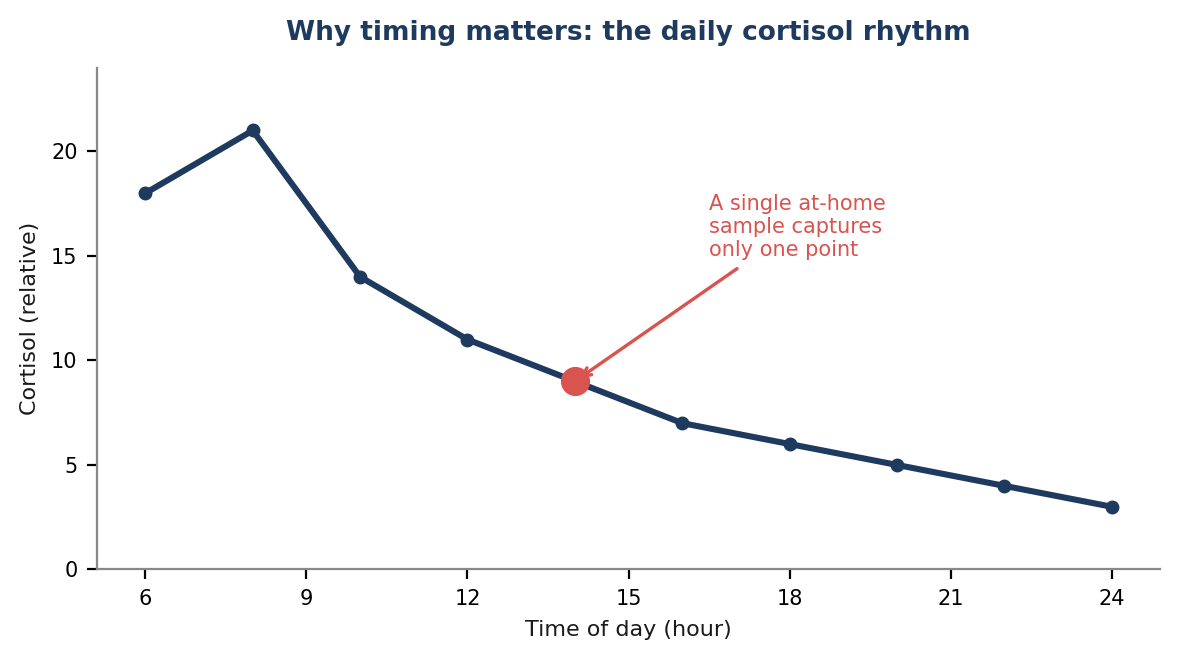
The biggest limitation of at-home hormone tests is not the technology. It is context. Hormones do not sit at a fixed level. They rise and fall across the day, shift across the menstrual cycle, and respond to stress, sleep, food, and exercise. A single sample captures one moment in a moving system, which is why timing can matter as much as the number itself.
Cortisol is the clearest example. In a healthy pattern, it peaks in the morning and tapers through the evening. A midday saliva sample tells you almost nothing about whether that whole curve is healthy. The same logic applies to reproductive hormones, where the day of your cycle changes what is normal. Research on salivary hormone analysis emphasizes exactly this point: reliable results depend on standardized collection and timing, and outpatient self-collection is where compliance and comparability often break down, as noted in a widely cited review of salivary hormone analysis published in Clinical Chemistry.
There is also the matter of interpretation. Most kits compare your result to a broad "normal" reference range. But normal is not the same as optimal, and a value that sits inside the standard range can still be low enough to leave you symptomatic. A number on a report does not explain why a hormone is off, whether other systems are involved, or what to do next. As even the Cleveland Clinic notes about blood tests, an abnormal result is not a diagnosis on its own. That gap between a data point and a decision is where at-home testing most often falls short.
Both approaches have a place. The table below compares them across the factors that most affect how much you can rely on a result.
At-home hormone tests are best understood as a screening and awareness tool rather than a diagnostic one. There are situations where they add real value, and others where they can mislead. Knowing the difference helps you use them wisely.
For men exploring symptoms like fatigue, low drive, or weight changes, a total testosterone reading is a common starting point, but as the Cleveland Clinic notes on low testosterone, a proper assessment usually calls for morning samples and often a repeat test before drawing conclusions. That kind of nuance is difficult to build into a single mail-in kit.
A functional and integrative approach starts from a different question. Instead of asking only "is this number in range," it asks "why is this hormone behaving this way, and what else is connected to it." Hormones rarely act alone. Thyroid, adrenal, blood sugar, gut health, sleep, and nutrient status all influence one another, so a single result is read as part of a web, not in isolation.
Rather than a preset kit, testing is chosen to match your symptoms and collected at the right time to be meaningful. This is the difference between a snapshot and a clear picture. Our approach to advanced lab testing focuses on getting reliable data the first time, so decisions rest on a solid foundation rather than a questionable number.
Standard reference ranges are built to flag disease, not to define how you feel at your best. Integrative interpretation looks at where a level sits within the range and how that lines up with your symptoms. A result that a generic report calls "normal" may still be worth addressing when it is paired with real, persistent complaints.
Once the picture is clear, the goal is a personalized care plan that addresses root causes through nutrition, lifestyle, and targeted support, then rechecks over time to confirm progress. Hormone balance is not a one-and-done event. It responds to consistent support and periodic reassessment. This is also why we serve patients through both in-person visits across Michigan and Zoom consultations in most US states, so follow-up stays practical.
Understanding what your hormone results actually mean starts with the right testing and a care team that reads them in context. Integrative Wellness Centers offers in-person care across Michigan and Zoom consultations for patients in most US states. If you are ready to stop guessing and start getting answers, you can book a consultation with our functional medicine team.
If you have already taken an at-home hormone test, the result is not wasted. Treat it as a conversation starter, not a verdict. Bring the report to a clinician who can weigh it against your symptoms, your history, and, when needed, more precise or better-timed testing. A confusing or borderline result is a reason to look closer, not to self-treat.
If you have not tested yet and you are dealing with ongoing symptoms, it can be worth skipping straight to a professional evaluation. That way the right markers are chosen from the start, collected correctly, and interpreted with an eye toward why things are off. Patients often see meaningful change once the underlying drivers are addressed rather than a single hormone chased in isolation, and that clarity is hard to reach through a kit alone.
At-home hormone tests can measure real markers and offer a convenient starting point, but their accuracy depends heavily on timing, collection quality, and interpretation, and a single number rarely explains why a hormone is off. A functional medicine approach uses well-timed testing and optimal ranges to read results in the context of your whole health, which is why a kit result is best treated as a first step rather than a final answer.
These are some of the most common questions people ask about at-home hormone tests, drawn from what patients and searchers most want to know.
Are at-home hormone tests accurate?
They can be accurate for certain markers when collected correctly and analyzed by a quality lab, but accuracy drops when timing, technique, or handling are off. The bigger issue is interpretation, since a technically accurate number still needs context to be useful.
Do at-home hormone tests actually work?
Yes, in the sense that they measure real hormone levels and can flag something worth exploring. They work less well as a standalone diagnostic tool, because a single result does not reveal patterns, root causes, or what to do next.
What hormones can you test at home?
Common at-home panels cover sex hormones such as estradiol, progesterone, and testosterone, the stress hormone cortisol, thyroid markers like TSH, and reproductive hormones such as FSH and LH. The exact list depends on the kit you choose.
Are at-home hormone tests covered by insurance?
Most direct-to-consumer kits are paid out of pocket and are not billed through insurance. Clinical testing ordered through a provider is more likely to be covered, though coverage varies by plan and situation.
Can an at-home hormone test detect perimenopause?
It may show shifts in hormones like FSH and estradiol that are consistent with perimenopause, but these levels fluctuate so much that a single reading is unreliable. Perimenopause is diagnosed primarily from symptoms and pattern over time, not one test.
Do at-home hormone tests require fasting?
It depends on the markers and the method. Some blood-based panels ask you to sample in the morning or while fasting, while many saliva and urine collections have their own timing rules. Following the kit instructions exactly is essential for a usable result.
Should I see a doctor after an at-home hormone test?
Yes, especially if your result is abnormal, borderline, or does not match how you feel. A clinician can confirm the finding with better-timed testing and interpret it alongside your full health picture rather than in isolation.
If this article reflects what you have been going through, the next step is finding out what your hormones are really telling you. Integrative Wellness Centers has supported patients since 2012, both in-person across Michigan and via Zoom in most US states, using well-timed testing and root-cause interpretation. You can request a new patient consultation to start the conversation with our care team.
Medical Disclaimer: This article is for informational and educational purposes only. It is not intended as medical advice and should not replace consultation with a qualified healthcare provider. Integrative Wellness Centers makes no claims to diagnose, treat, cure, or prevent any disease. Always consult your doctor before making changes to your health regimen or discontinuing any medication.

Take the online digestive evaluation to instantly discover what systems of your body are the cause of your health issues.
Online Digestive EvaluationTake the TestOnline Female Hormone EvaluationOnline Male Hormone Evaluation


