
Recognize early autoimmune disease symptoms and the root causes behind them, and how a functional medicine approach in Michigan looks deeper.
For years, you may have noticed something was off. The fatigue that sleep never fixes. The joints that ache for no clear reason. The brain fog, the stubborn skin flares, the digestion that turns on you without warning. You bring these autoimmune disease symptoms to appointment after appointment, and too often you hear the same frustrating sentence: your labs look normal. When your experience does not match your results, it is easy to start wondering whether the problem is all in your head. It is not.
This article walks through the early warning signs of autoimmune conditions, why these symptoms are so often missed or dismissed, and what actually drives them beneath the surface. It also explains how a functional and integrative medicine perspective looks at the whole picture rather than one lab value at a time. At Integrative Wellness Centers in Michigan, the focus is on understanding what your symptoms are trying to tell you, using detailed testing and a root cause approach rather than a wait and see one.
If you have been searching for answers about autoimmune disease symptoms and feel like conventional visits have not addressed what is actually driving them, you are not alone.
Integrative Wellness Centers works with patients in person across Michigan and via Zoom in most US states to look deeper into these patterns. You can schedule a new patient consultation to talk through your specific situation with our care team.
Autoimmune conditions are more common than most people realize, and they are becoming more common over time. According to the National Institute of Environmental Health Sciences, autoimmune diseases affect more than 24 million people in the United States, and the large majority of those diagnosed are women. Research summarized in the National Library of Medicine notes that roughly 80 percent of autoimmune patients are women, a disparity researchers are still working to fully explain.

The reason early recognition matters is simple. Autoimmune disease develops when the immune system, which is meant to protect you, begins mistakenly targeting your own healthy tissue. That process usually builds quietly for years before a formal diagnosis. During that window, symptoms come and go, get blamed on stress or aging, and slowly chip away at quality of life. Noticing the early warning signs and taking them seriously gives you the best chance to support your body before the pattern becomes more entrenched.
An autoimmune disease is a condition in which the immune system loses the ability to tell the difference between your own cells and outside threats, so it begins attacking healthy tissue. As the Cleveland Clinic explains in its overview of autoimmune diseases, there are more than 100 recognized autoimmune conditions, and they can affect nearly any part of the body, from the thyroid and joints to the skin, gut, and nervous system.
Because so many different tissues can be involved, autoimmune symptoms are wide ranging. Some show up in one specific area, like the thyroid in Hashimoto’s or the joints in rheumatoid arthritis. Others are body wide and vague, which is exactly what makes them hard to pin down. Common early warning signs that patients report include:
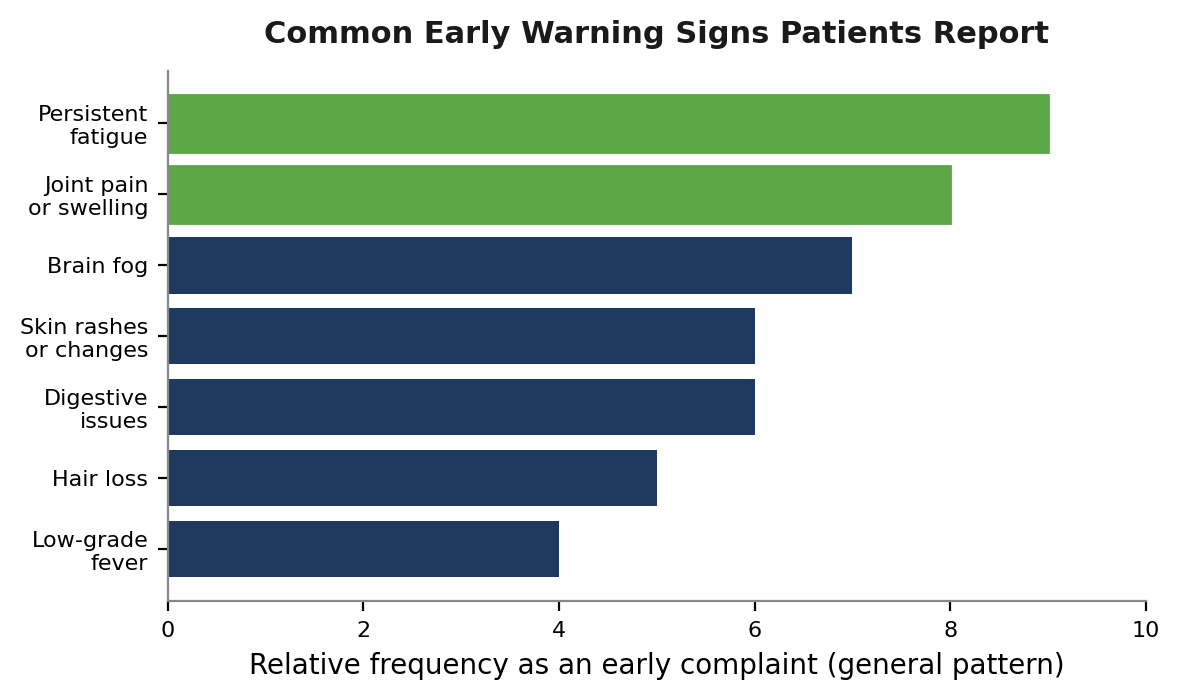
One of the most telling features of autoimmune symptoms is that they often come and go in flares. You might feel almost normal for weeks, then hit a stretch where everything flares at once. That on again, off again quality is a clue that the immune system is involved, not a sign that nothing is wrong.
Many patients spend years cycling between specialists before anyone connects the dots. There are a few reasons this happens. First, autoimmune symptoms rarely arrive as a neat, single complaint. Fatigue goes to one provider, joint pain to another, skin issues to a third, and no one is looking at the full pattern across systems.
Second, standard bloodwork is often interpreted against broad reference ranges that are designed to catch established disease, not the early or borderline changes that come before it. A result can fall inside the standard lab range and still sit far from what is considered optimal. Research indexed in the National Library of Medicine on the rising incidence of autoimmune disease highlights how underrecognized these conditions remain, particularly in women whose symptoms are more likely to be attributed to stress or hormones.
The table below illustrates the difference in mindset between a symptom focused approach and a root cause approach. Neither replaces appropriate medical care, but the contrast explains why some patients feel unheard for so long.
Autoimmune conditions do not appear out of nowhere. Genetics load the gun, but environment and lifestyle often pull the trigger. A functional medicine approach spends most of its energy on the triggers, because those are the factors you can actually influence. Several root contributors show up again and again.
A large portion of the immune system lives in and around the gut. When the intestinal lining becomes more permeable than it should be, a state often described as increased intestinal permeability, particles can cross into the bloodstream and provoke an ongoing immune response. Addressing gut health is frequently one of the first steps in supporting people with autoimmune patterns.
Ongoing stress keeps the body in a heightened state that can dysregulate immune function over time. Many patients can trace the start of their symptoms to a period of intense or prolonged stress, whether physical, emotional, or both. The search data around autoimmune conditions reflects this, with terms like stress and autoimmune among the most frequently searched.
Nutrients like vitamin D, certain B vitamins, and minerals play direct roles in immune regulation. Deficiencies are common and often overlooked. Diet also matters, which is why so many people search for the best diet for autoimmune conditions and anti inflammatory eating patterns. Food is not a cure, but it is a powerful lever for reducing the inflammatory load the immune system is responding to.
Environmental exposures, including certain toxins and mold, along with past or lingering infections such as Epstein Barr, are recognized as potential contributors to immune dysregulation. Identifying and reducing these triggers is part of a thorough root cause evaluation rather than an afterthought.
A functional and integrative approach starts from a different question. Instead of asking only which disease this is, it asks why the immune system is behaving this way and what can be done to support balance. That shift shapes everything that follows.
The foundation is detailed testing that goes beyond a basic panel. This can include a wide functional blood panel that evaluates immune markers, inflammation, nutrient status, thyroid health, and multiple autoimmune markers, read against optimal ranges rather than standard ones alone. You can learn more about advanced lab testing at Integrative Wellness Centers and how it is used to build a clearer picture of what is happening beneath the symptoms.
No two people with autoimmune symptoms are identical, even when their diagnosis is the same. Testing results, health history, and personal goals inform a personalized care plan that targets the specific drivers found rather than a one size fits all protocol. The aim is to support the body’s own capacity to move toward balance.
Nutrition strategy, stress support, sleep, and targeted supplementation are woven into the plan, and progress is tracked over time with follow up testing so the approach can be adjusted. This is where an approach to autoimmune conditions at Integrative Wellness Centers becomes a partnership rather than a single appointment. Care is available in person across Michigan and through Zoom for patients in most US states.
Understanding the root cause of autoimmune disease symptoms starts with the right testing and a care team that takes the time to listen. Integrative Wellness Centers offers in person care across Michigan and Zoom consultations for patients in most US states. If you are ready to stop guessing and start getting answers, you can book a consultation with our functional medicine team.
It helps to set honest expectations. Autoimmune patterns usually develop over years, so supporting the body is a process measured in months, not days. Many patients work through a structured care plan that often spans several months, giving the body time to respond as triggers are addressed and inflammation is calmed. The body has a remarkable capacity to move toward balance when it is given the right support and the underlying drivers are identified rather than ignored.
Progress is rarely a straight line. Symptoms may ease, plateau, then ease again as different root causes are addressed in turn. What tends to change first for many people is the sense of finally understanding why they feel the way they do, which is its own kind of relief after years of uncertainty.
Autoimmune disease symptoms like fatigue, joint pain, brain fog, and skin or digestive changes often appear years before a diagnosis and are frequently missed when labs are read only against standard ranges. A functional medicine approach looks for root causes such as gut health, chronic stress, nutrient status, and environmental triggers, using detailed testing and personalized care. Integrative Wellness Centers supports patients in person across Michigan and via Zoom in most US states.
These are some of the most common questions people ask when they first start connecting their symptoms to a possible autoimmune pattern. The answers are educational and are not a substitute for an evaluation with a qualified provider.
1. What are the early signs of an autoimmune disease?
Common early signs include persistent fatigue, joint pain or stiffness, brain fog, skin rashes, digestive changes, and hair loss. These symptoms often come and go in flares, which is one reason they are easy to dismiss in the early stages.
2. Can you have an autoimmune disease without obvious symptoms?
Yes. Autoimmune activity can build quietly for years before symptoms become noticeable, and some people have detectable autoimmune markers well before they feel unwell. This is part of why detailed testing and optimal range interpretation can be valuable.
3. Can autoimmune disease symptoms come and go?
They very often do. Many autoimmune conditions move through flares and calmer periods, so symptoms can intensify for a stretch and then quiet down. That fluctuating pattern is a meaningful clue rather than a sign that nothing is wrong.
4. What autoimmune diseases cause hair loss?
Several autoimmune conditions are associated with hair loss, including thyroid related conditions such as Hashimoto’s and conditions like alopecia areata. Because hair loss has many possible causes, thorough testing helps identify whether an autoimmune process is involved.
5. Why does autoimmune disease occur?
Autoimmune disease develops when the immune system mistakenly targets healthy tissue. Genetics create susceptibility, while triggers like gut dysfunction, chronic stress, nutrient deficiencies, infections, and environmental exposures often set the process in motion.
6. Do autoimmune diseases run in families?
There is often a genetic component, and autoimmune conditions can cluster in families. Having a family history raises susceptibility, but environment and lifestyle play a large role in whether and how symptoms actually develop.
7. Are autoimmune disease symptoms more common in women?
Yes. Research indicates that roughly 80 percent of people with autoimmune conditions are women. Symptoms in women are also more likely to be attributed to stress or hormones, which can delay recognition of an underlying autoimmune pattern.
If this article resonated with what you have been going through, the next step is finding out whether a functional medicine approach is the right fit for your situation. Integrative Wellness Centers has supported thousands of patients since 2012, both in person across Michigan and via Zoom in most US states. You can request a new patient consultation to start the conversation with our care team.
Medical Disclaimer: This article is for informational and educational purposes only. It is not intended as medical advice and should not replace consultation with a qualified healthcare provider. Integrative Wellness Centers makes no claims to diagnose, treat, cure, or prevent any disease. Always consult your doctor before making changes to your health regimen or discontinuing any medication.

Take the online digestive evaluation to instantly discover what systems of your body are the cause of your health issues.
Online Digestive EvaluationTake the TestOnline Female Hormone EvaluationOnline Male Hormone Evaluation


