
Learn the early signs of autoimmune disease, why standard labs miss them, how testing works, and when to get tested. A functional medicine guide from IW Centers.
You have felt off for months, maybe longer. The fatigue does not lift after a good night of sleep, your joints ache for no clear reason, your hair is thinning, and your mind feels foggy in the afternoon. You bring it up at an appointment, your standard labs come back "normal," and you leave with the sense that no one is connecting the dots. If that sounds familiar, you are not imagining it. The early signs of autoimmune disease are often vague, easy to dismiss, and scattered across different parts of the body, which is exactly why they get missed for so long.
This guide walks through the early warning signs of autoimmune disease, why they are so frequently overlooked, how autoimmune conditions are actually tested for, and when it makes sense to ask for that testing. It is written from a functional and integrative medicine perspective, which looks at patterns and root causes rather than waiting for a single lab value to cross a hard threshold. At Integrative Wellness Centers in Michigan, this is the lens our care team uses every day with patients who feel unheard and want real answers.
If you have been searching for answers about early autoimmune symptoms and feel like conventional visits have not addressed the root cause, you are not alone. Integrative Wellness Centers works with patients in person across Michigan and by Zoom in most US states to understand what is actually driving these symptoms. You can schedule a new patient consultation to talk through your specific situation with our care team.
Autoimmune conditions are common and rising. Research summarized by the NIH Office of Autoimmune Disease Research describes at least 80 recognized autoimmune diseases affecting an estimated eight percent of the population, and roughly 80 percent of those diagnosed are women. That last point matters, because women reporting early, nonspecific symptoms are often the ones told their labs look fine.
The reason early recognition matters is simple. Autoimmune disease develops on a spectrum. The immune system usually begins producing antibodies against the body's own tissue years before a condition is obvious enough to name. During that window, symptoms tend to come and go, which makes them easy to explain away as stress, aging, or a busy season of life. Noticing the pattern early gives you the chance to investigate, adjust the factors within your control, and monitor changes over time instead of waiting for a flare that is harder to ignore.
An autoimmune disease is a condition in which the immune system, which normally defends against viruses and bacteria, mistakenly attacks the body's own healthy tissue. According to Cleveland Clinic, these are chronic conditions, and there are more than 80 of them affecting nearly every system of the body, from the thyroid and joints to the skin, gut, and nervous system.
Because so many different tissues can be targeted, autoimmune disease does not have one single presentation. Hashimoto's affects the thyroid, rheumatoid arthritis affects the joints, celiac affects the gut, and lupus can affect several systems at once. What most of these conditions share early on is a set of overlapping, whole-body symptoms that are easy to confuse with everyday tiredness or a passing illness.
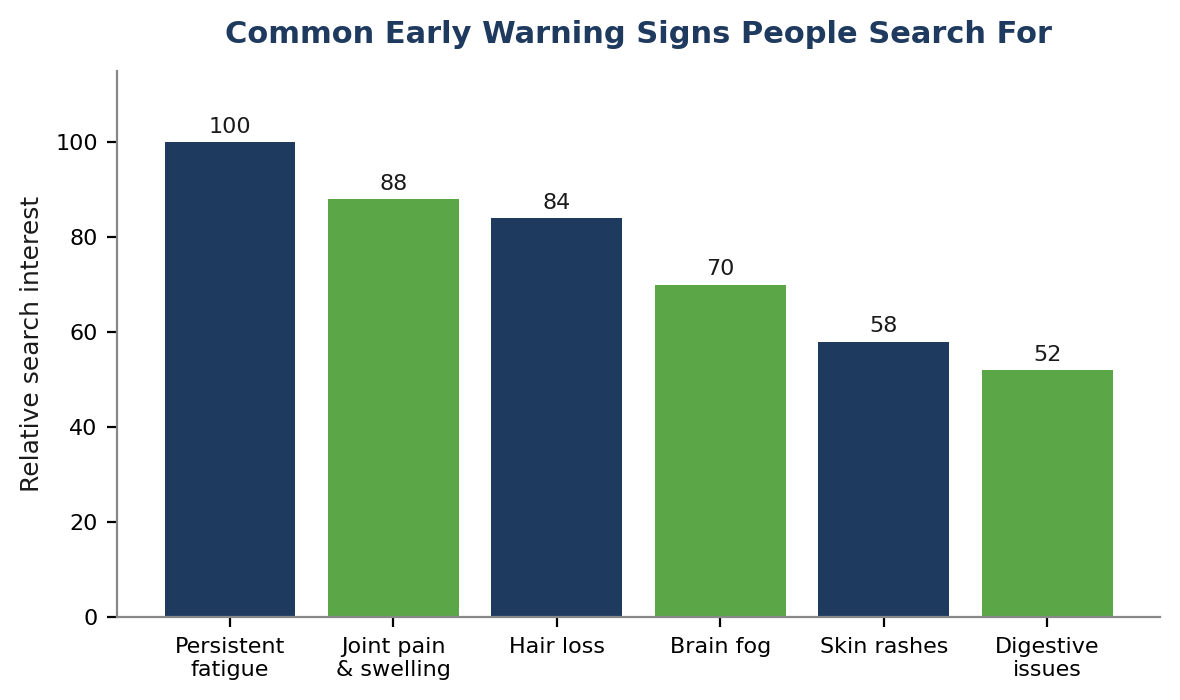
These are the signs people most often notice first. One on its own is rarely alarming. Several together, especially when they persist or keep returning, are worth investigating.
Fatigue combined with joint pain is one of the most searched symptom pairings, and for good reason. It shows up early across several autoimmune conditions and is one of the clusters that most often gets brushed aside.
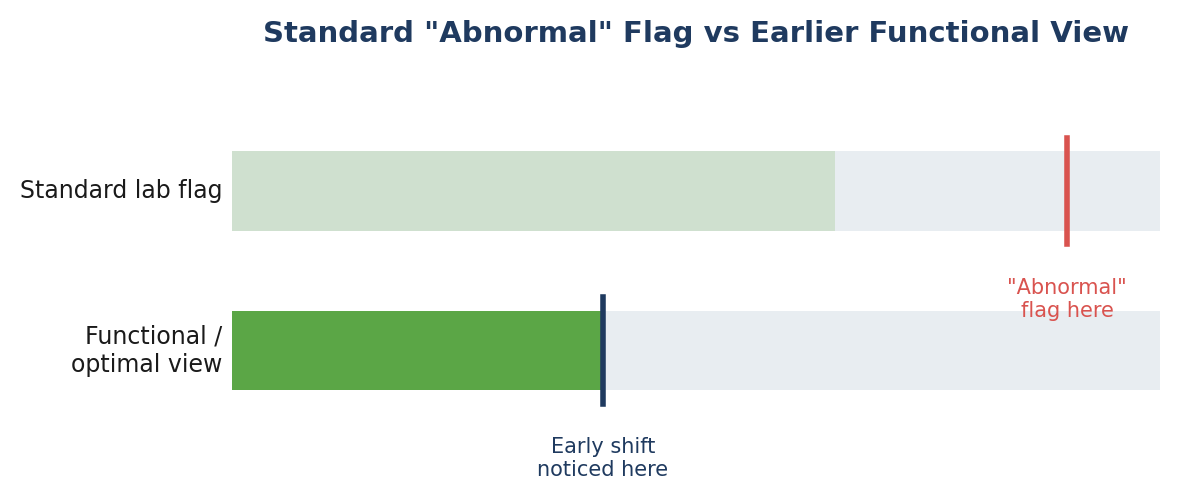
There is nothing wrong with conventional medicine. It excels at acute problems and clear diagnoses. The gap tends to appear in the early, in-between stage of autoimmunity, and it usually comes down to how standard testing is designed and read.
Standard lab ranges are built to flag disease that has already progressed, not the earlier drift toward it. A marker can move meaningfully in the wrong direction and still sit inside the "normal" band, so the report reads as reassuring even when your body is telling a different story. Early antibody activity can also be subtle. A Cleveland Clinic Journal of Medicine article notes how common, nonspecific symptoms like fatigue, brain fog, and generalized pain can be difficult to interpret, and how a low-level positive antibody result is not always the full story. This cuts both ways. Some people are dismissed too early, and others are handed an incomplete picture.
The other issue is fragmentation. A thyroid symptom goes to one specialist, a joint symptom to another, a skin symptom to a third. Each visit treats a piece, and no one steps back to ask whether a single underlying process could be driving all of it. That whole-person view is precisely what a functional approach is built around.
No single thing "causes" autoimmunity. Most researchers describe it as a combination of genetic susceptibility plus one or more triggers that tip the immune system out of balance. A functional evaluation spends its time here, looking at the factors that can be identified and addressed rather than stopping at the label.
The connection between stress and autoimmune flares is one of the most searched topics in this space, and the interest is well placed. Sustained stress keeps the body in a heightened inflammatory state, which can influence how the immune system behaves. Many people can point to a stressful period or a significant life event in the months before their symptoms began.
A large share of the immune system lives in and around the gut, so gut function and immune function are closely tied. When the gut lining becomes more permeable, the immune system is exposed to substances it would normally keep at a distance, which can contribute to ongoing immune activation. This is why gut health comes up so often in autoimmune conversations.
Certain viral and bacterial infections have long been studied as potential triggers in susceptible people. Environmental exposures and shortfalls in key nutrients such as vitamin D can also influence immune regulation. None of these acts alone, but together they help explain why one person develops symptoms and another with similar genetics does not.
The strong skew toward women points to hormones as part of the picture. As research indexed on PubMed has documented, autoimmune diseases affect women far more often than men, and sex hormones are thought to play a meaningful role in that difference. For many women, symptoms also shift around hormonal transitions, which is one more reason a whole-picture evaluation is useful.
Testing for autoimmune disease is rarely a single test. It is usually a combination of markers reviewed together, alongside your symptom history. Understanding the main categories helps you have a more informed conversation, whether with us or with your current provider.
These are the tests most often used to screen for and support an autoimmune evaluation. What matters is not just whether a marker is flagged, but how the results fit together and track over time.
A single result rarely tells the whole story. A positive ANA does not confirm a disease on its own, and a negative result does not always rule autoimmunity out. That is why context and follow-up matter so much.
A functional evaluation starts with a detailed history and then uses testing to investigate the pattern, not just to confirm or deny a single diagnosis. That can include the standard antibody and inflammation markers above, plus a closer look at advanced lab testing for gut function, nutrient status, and other contributors. The goal is testing, not guessing, so that decisions are grounded in your actual data.
Once there is a clear picture, the next step is a personalized care plan focused on the factors that can be supported, such as stress load, gut health, nutrition, and sleep. Because autoimmunity moves on a spectrum, monitoring over time is part of the process. For people whose symptoms center on the immune system, our autoimmune care page explains how this whole-person approach fits together
Understanding early autoimmune signs starts with the right testing and a care team that takes the time to connect the dots. Integrative Wellness Centers offers in person care across Michigan and Zoom consultations for patients in most US states. If you are ready to stop guessing and start getting answers, you can book a consultation with our functional medicine team.
There is no perfect single moment, but a few situations make testing worth pursuing. If you recognize yourself in several of these, it is reasonable to ask for a fuller evaluation.
If you have already been told your results are normal and something still feels wrong, that is not a dead end. It is often the right moment for a second, more complete look at the full pattern.
It helps to set realistic expectations. Autoimmune conditions are chronic, and the goal of a functional approach is not a quick fix. It is to identify and support the underlying drivers so the immune system has a better environment to settle into. Many patients follow a care plan over several months, commonly in the range of four to seven months, because meaningful change in immune balance, gut health, and nutrient status takes time.
The encouraging part is that many of the biggest contributors, including stress, sleep, gut health, and nutrition, are things you can actually work on with the right guidance. The body is remarkably capable of finding better balance when the factors working against it are addressed rather than ignored.
Early autoimmune disease often shows up as persistent fatigue, joint pain, hair loss, brain fog, and other whole-body symptoms that standard labs frequently read as "normal." Testing usually combines several markers, such as ANA, inflammatory markers, and specific antibodies, reviewed together with your history rather than in isolation. If symptoms persist, cluster together, or follow a major stressor, a more complete functional evaluation is a reasonable next step.
These are some of the most common questions people search when they suspect an autoimmune issue. The answers are general and educational, not a substitute for a personal evaluation.
What autoimmune disease causes hair loss?
Several can. Autoimmune thyroid conditions such as Hashimoto's, alopecia areata, and lupus are among the conditions associated with hair loss or thinning. Because hair loss has many possible causes, it is best evaluated alongside your other symptoms and lab markers rather than on its own.
What autoimmune disease causes fatigue and joint pain?
This combination shows up across several conditions, including rheumatoid arthritis, lupus, and autoimmune thyroid disease. Fatigue paired with joint pain is one of the most common early clusters, which is exactly why it deserves a closer look when it persists.
Why does autoimmune disease occur?
Most experts describe it as genetic susceptibility combined with one or more triggers, such as chronic stress, gut issues, infections, or environmental exposures. No single factor acts alone, which is why a functional evaluation looks at the whole pattern rather than one cause.
Are autoimmune diseases more common in women?
Yes. Research consistently finds that roughly 80 percent of people diagnosed with autoimmune disease are women, and hormones are thought to be part of the reason. This is one reason women with early, nonspecific symptoms deserve a thorough evaluation rather than a quick dismissal.
How is autoimmune disease tested for?
Testing usually combines several blood markers, including an ANA screen, inflammatory markers like CRP and ESR, and condition-specific antibodies, read together with your symptom history. A single result rarely confirms or rules out autoimmunity by itself.
Can stress cause autoimmune disease?
Stress is widely studied as a trigger and a factor in flares rather than a sole cause. Sustained stress keeps the body in a more inflammatory state, and many people can link the start of their symptoms to a stressful period, which is why stress management is often part of a care plan.
My labs are normal but I still feel sick. What now?
Normal standard labs do not always rule out early autoimmune activity, because standard ranges are set to catch more advanced disease. A more complete functional review of the full pattern, including markers and history, is often the useful next step.
If this article reflects what you have been going through, the next step is finding out whether a functional approach fits your situation. Integrative Wellness Centers has supported patients since 2012, both in person across Michigan and by Zoom in most US states. You can request a new patient consultation to start the conversation with our care team.
Medical Disclaimer: This article is for informational and educational purposes only. It is not intended as medical advice and should not replace consultation with a qualified healthcare provider. Integrative Wellness Centers makes no claims to diagnose, treat, cure, or prevent any disease. Always consult your doctor before making changes to your health regimen or discontinuing any medication.

Take the online digestive evaluation to instantly discover what systems of your body are the cause of your health issues.
Online Digestive EvaluationTake the TestOnline Female Hormone EvaluationOnline Male Hormone Evaluation


