
Understand your thyroid panel: what TSH, Free T3, and Free T4 mean, why "normal" results still miss problems, and how a root-cause approach reads your numbers.
If you have been feeling exhausted, foggy, cold, or watching the scale creep up for no clear reason, a thyroid panel is often the first blood test that gets ordered. And yet many people walk out of that appointment with the same frustrating sentence: "Your thyroid is normal." You know something is off, but the lab result says otherwise, and no one seems to be connecting the dots. Understanding your thyroid panel, and specifically what TSH, Free T3, and Free T4 each measure, is the first step to getting real answers instead of a shrug.
This guide breaks down each marker in plain language, explains why a single TSH value rarely tells the whole story, and shows how a more complete thyroid panel can reveal patterns that a basic screen misses. We will also look at how a functional and integrative medicine approach reads these numbers differently, using optimal ranges rather than only the broad reference ranges printed on a standard lab report. At Integrative Wellness Centers in Michigan, this kind of deeper, root-cause interpretation is central to how our care team helps patients who feel unheard finally understand what their thyroid results are actually saying.
If you have been told your thyroid labs are "fine" but you still do not feel like yourself, you are not alone. Integrative Wellness Centers works with patients in-person across Michigan and via Zoom in most US states to look beyond a single number and identify what is driving your symptoms. You can schedule a new patient consultation to review your thyroid panel with our care team.
Your thyroid is a small, butterfly-shaped gland in your neck, but it influences nearly every system in your body: metabolism, heart rate, body temperature, mood, energy, digestion, and more. When it is even slightly out of balance, the effects ripple everywhere, which is exactly why thyroid symptoms are so easy to blame on stress, aging, or a busy lifestyle.
The scale of this is larger than most people realize. Research suggests that roughly 4 to 5 percent of the US population has hypothyroidism, and a significant share of thyroid dysfunction goes undiagnosed because symptoms are vague and overlap with so many other conditions. Women are affected far more often than men, and thyroid symptoms frequently surface during major hormonal transitions such as perimenopause. That overlap is precisely why the right testing, read the right way, matters so much.
A thyroid panel is the tool that turns a collection of vague complaints into measurable data. But the value of that data depends entirely on which markers are tested and how carefully they are interpreted. A panel that only checks TSH can look reassuring while still missing an early or developing problem.
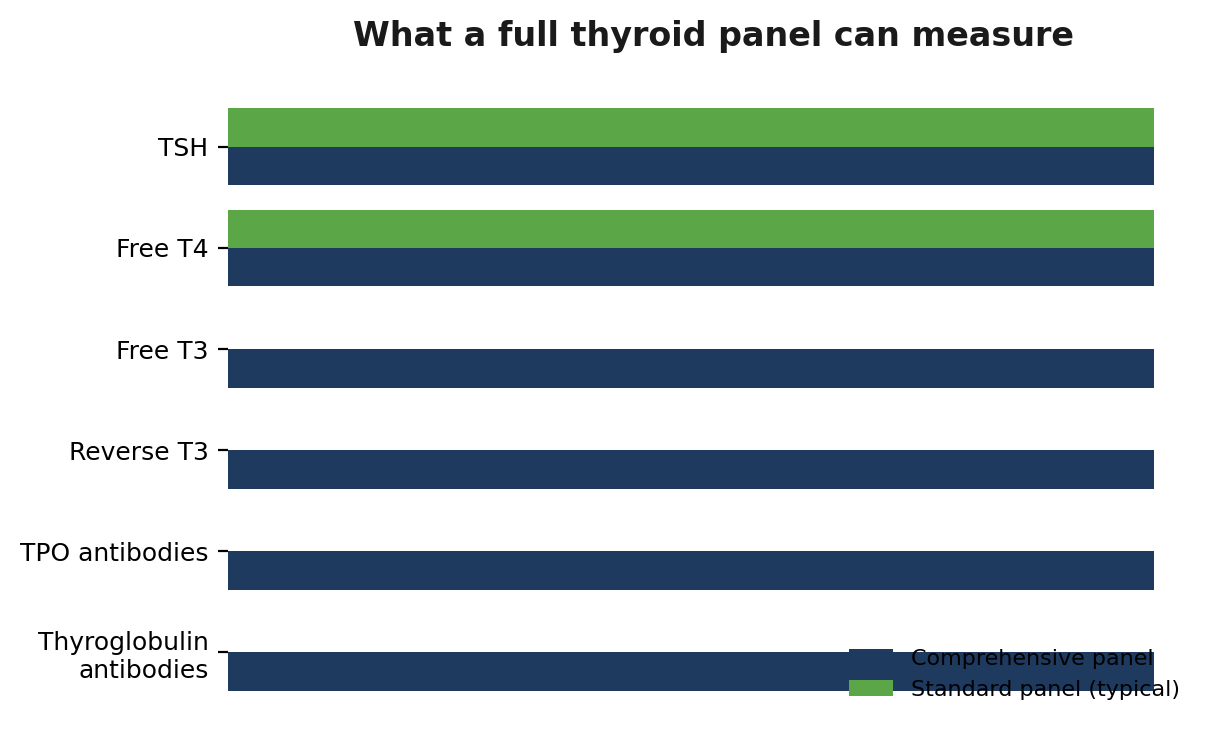
A thyroid panel is a blood test that measures certain hormones your thyroid makes, along with thyroid-related antibodies. According to Cleveland Clinic, a thyroid panel typically measures TSH, free and total T4, free and total T3, and thyroid antibodies such as TPO. The combination of these markers gives a fuller picture of how your thyroid is producing hormone, how your body is converting it, and whether your immune system may be involved.
Here is what each core marker on your panel means:
Most conventional thyroid screening starts and often ends with TSH. If TSH falls inside the standard reference range, the workup frequently stops there. For many people this is enough, and there is real evidence that TSH alone is adequate for monitoring established hypothyroidism. A Cleveland Clinic clinical review notes that a serum TSH is often sufficient for adjusting thyroid hormone dosing in straightforward cases. The problem is that "often sufficient" is not the same as "always complete," especially for someone with real symptoms and a borderline result.
There are two blind spots worth understanding. The first is the reference range itself. Standard lab ranges are statistically broad, and a TSH near the top of that range can be labeled normal even when it sits well above where many people feel well. The second is the missing markers. If Free T3, Reverse T3, and antibodies are never measured, a conversion problem or an early autoimmune process can go completely undetected while TSH still reads "normal."
This gap is not a small one. Because symptoms of low thyroid function are nonspecific and overlap heavily with other conditions, a large portion of thyroid dysfunction goes unrecognized. A review on the under-diagnosis of hypothyroidism found that a substantial share of cases in the US and Europe remain undiagnosed, in part because people and providers attribute the symptoms to other causes. Reading a fuller panel against optimal ranges is how those hidden patterns come to light.

When a thyroid panel comes back abnormal, or normal despite clear symptoms, a functional medicine approach asks why. The thyroid rarely malfunctions in isolation. These are the common underlying drivers our care team looks for.
Autoimmune thyroiditis, or Hashimoto’s, is the most common cause of low thyroid function in areas with adequate iodine. The immune system gradually attacks the thyroid, so TPO and thyroglobulin antibodies can be elevated years before TSH moves out of range. This is exactly the kind of early signal a TSH-only screen misses.
Your thyroid depends on specific building blocks. Shortfalls in iodine, selenium, zinc, iron, and vitamin D can impair both hormone production and the conversion of T4 into active T3. Addressing these gaps is often part of supporting healthier thyroid function.
Ongoing stress raises cortisol, which can push the body to convert T4 into Reverse T3 instead of active Free T3. On paper TSH and T4 may look acceptable, yet the active hormone your cells need is in short supply. This is why Free T3 and Reverse T3 add so much context.
A meaningful portion of T4 to T3 conversion is influenced by gut health, and chronic inflammation or an imbalanced microbiome can interfere with it. Because roughly the same systems govern immune regulation, gut issues and autoimmune thyroid conditions frequently travel together.
An integrative approach does not throw out conventional thyroid testing. It expands it and then interprets the results in the context of your whole health, not a single line on a lab printout.
Rather than testing TSH alone, a comprehensive workup typically looks at the full set of markers together: TSH, Free T4, Free T3, Reverse T3, and thyroid antibodies, often alongside nutrient and inflammatory markers. This is the philosophy behind our advanced lab testing approach, which is built on testing rather than guessing. Seeing the markers side by side is what reveals conversion problems and early autoimmunity.
The same numbers are read differently. Instead of asking only whether a value is inside the broad reference range, our care team asks whether it sits where people with your profile tend to feel and function well. A high-normal TSH paired with real symptoms is treated as information worth acting on, not a result to dismiss.
From there, support is individualized. That can include targeted nutrition, addressing nutrient gaps, stress and sleep strategies, and gut support, with follow-up testing to track change over time. You can read more about how this fits together on our thyroid care page for Michigan patients. The goal is to support the body’s own capacity to function well, then monitor and adjust.
Understanding the root cause of a confusing thyroid panel starts with the right testing and a care team that takes the time to read it fully. Integrative Wellness Centers offers in-person care across Michigan and Zoom consultations for patients in most US states. If you are ready to stop guessing and start getting answers, you can book a consultation with our functional medicine team.
Getting a complete, well-interpreted thyroid panel is not an overnight fix, and honest expectations matter. Supporting thyroid function is a process that unfolds over months, not days, because the underlying drivers, whether autoimmune, nutritional, or stress-related, took time to develop and take time to address.
In practice, patients often move through their care plan over a span of several months, with repeat testing to see how the markers are trending and how symptoms are shifting alongside them. Many people find real value simply in finally understanding what their numbers mean and why they have felt the way they have. That clarity, paired with a plan built around your specific results, is what makes the difference between chasing symptoms and addressing the cause.
A thyroid panel measures TSH, Free T4, and Free T3, and a fuller panel adds Reverse T3 and antibodies, but a TSH-only screen read against broad reference ranges often looks "normal" while still missing conversion problems or early autoimmunity. A functional medicine approach tests the complete set of markers and interprets them against optimal ranges to find the root cause behind your symptoms, which is why people who were told their thyroid is fine sometimes still have answers waiting in a more complete workup.
These are the questions patients most often ask when trying to make sense of thyroid panel testing and their results. The answers below are educational and are not a substitute for a personalized evaluation.
1. What is included in a full thyroid panel?
A full thyroid panel usually includes TSH, Free T4, and Free T3, and a comprehensive version adds Reverse T3 and thyroid antibodies such as TPO and thyroglobulin. The exact combination can vary, so it is worth confirming which markers are being measured rather than assuming "thyroid panel" always means the complete set.
2. Do you have to fast for a thyroid panel?
For most thyroid blood tests, fasting is not strictly required, and Cleveland Clinic notes that you usually do not need special preparation. That said, timing and certain supplements such as biotin can affect results, so follow the specific instructions your provider gives you.
3. What is the difference between TSH and a full thyroid panel?
TSH is a single hormone made by the pituitary that signals the thyroid, while a full panel measures TSH plus the actual thyroid hormones (Free T4 and Free T3) and often antibodies. TSH alone can look normal even when the active hormone or an autoimmune process tells a different story.
4. How do I interpret my thyroid panel results?
Interpretation means looking at the markers together rather than one value in isolation, and comparing them against optimal ranges instead of only the broad reference range. Because context matters so much, results are best reviewed with a clinician who can factor in your symptoms and history.
5. Can my thyroid panel be normal but I still have symptoms?
Yes, and this is common. A TSH within the standard range does not rule out an early or developing problem, a conversion issue, or autoimmune activity, which is why a fuller panel and optimal-range interpretation can uncover what a basic screen misses.
6. What does Free T3 tell me that TSH does not?
Free T3 is the active hormone that drives your metabolism at the cellular level, so it often reflects how you actually feel. TSH only reflects the pituitary signal, so someone can have normal TSH but low Free T3 if their body is not converting hormone well.
7. How long does it take to get thyroid panel results?
Most thyroid blood test results come back within a few days, though timing depends on the lab and which markers are ordered. Your care team will review them with you and explain what the numbers mean in the context of your symptoms.
If this breakdown helped you make sense of your own results, the next step is finding out whether a complete thyroid workup and a root-cause reading are right for your situation. Integrative Wellness Centers has supported patients since 2012, both in-person across Michigan and via Zoom in most US states. Request a new patient consultation to start the conversation with our care team.
Medical Disclaimer: This article is for informational and educational purposes only. It is not intended as medical advice and should not replace consultation with a qualified healthcare provider. Integrative Wellness Centers makes no claims to diagnose, treat, cure, or prevent any disease. Always consult your doctor before making changes to your health regimen or discontinuing any medication.

Take the online digestive evaluation to instantly discover what systems of your body are the cause of your health issues.
Online Digestive EvaluationTake the TestOnline Female Hormone EvaluationOnline Male Hormone Evaluation


