
Learn the signs of vitamin D deficiency, why normal labs can miss it, and how functional medicine restores optimal levels with testing, not guessing.
You feel tired more days than not. Your muscles ache for no clear reason, your mood dips every winter, and you seem to catch every cold that goes around. When you finally ask your doctor about it, the bloodwork comes back and you hear the familiar words: everything looks normal. For many people, one of the most overlooked answers is vitamin D deficiency, a problem that affects a large share of American adults and is especially common in northern states like Michigan, where meaningful sun exposure disappears for nearly half the year.
This article walks through what vitamin D actually does in your body, the signs that your levels may be low, why a lab result marked normal does not always mean optimal, the root causes that keep levels low even in people who supplement, and how a functional medicine approach restores vitamin D in a way that lasts. It reflects the same testing-first philosophy Integrative Wellness Centers has used with patients since 2012: measure precisely, address the underlying cause, and support the body instead of chasing symptoms.
If you suspect low vitamin D is behind your fatigue, low mood, or frequent illness and conventional care has not gotten to the bottom of it, you are not alone. Integrative Wellness Centers works with patients in-person across Michigan and via Zoom in most US states to uncover what is actually driving these symptoms. You can schedule a new patient consultation to discuss your specific situation with our care team.
Vitamin D is not just a vitamin. It functions as a hormone that interacts with receptors in nearly every tissue in the body, which is why low levels show up in so many different ways. Research published in Nutrition Research using national NHANES data found that roughly 41 percent of US adults had vitamin D levels at or below 20 ng/mL, the threshold for outright deficiency. That is before counting the much larger group sitting in the insufficient zone just above it.
Left unaddressed, chronically low vitamin D is associated with weaker bones and higher fracture risk, muscle weakness, low mood, poor immune resilience, and worse outcomes across several chronic conditions. Because the symptoms are vague and build slowly, most people adapt to feeling below their baseline and never connect the dots. In Michigan, the geography works against you too. From roughly November through March, the sun sits too low for your skin to produce meaningful vitamin D at all, so levels quietly drain through winter and often never fully recover in summer.
Vitamin D is a fat-soluble nutrient your body produces when ultraviolet B light hits bare skin. It is then converted by the liver into 25-hydroxyvitamin D, the storage form measured in blood tests, and finally activated by the kidneys. According to the Cleveland Clinic, vitamin D supports normal bone development and maintenance and also plays a role in the nervous system, musculoskeletal system, and immune system. When levels drop, the effects ripple across all of those systems.
Common signs and symptoms of vitamin D deficiency include:
Here is the tricky part: many people with low vitamin D have no obvious symptoms at all, and the symptoms above overlap heavily with thyroid dysfunction, iron deficiency, hormonal imbalance, and chronic stress. That is exactly why testing matters more than guessing, and why a symptom checklist alone should never be the end of the conversation.
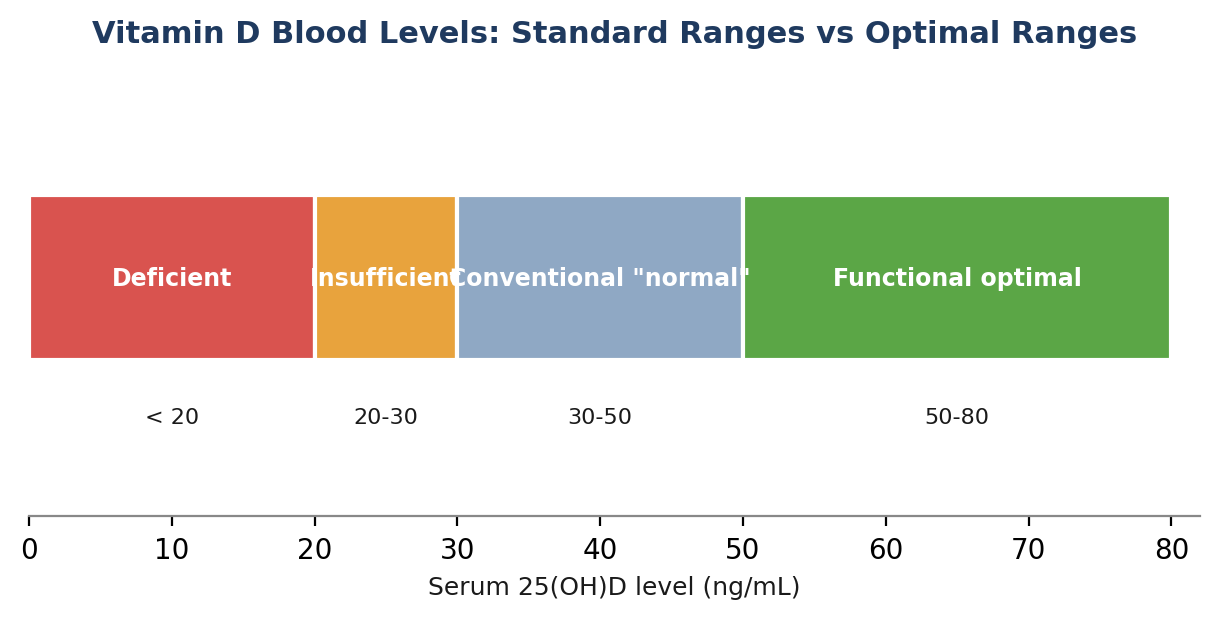
If you have had vitamin D checked and been told it was fine, the number itself deserves a second look. Most conventional labs flag a result only when it falls below 20 or 30 ng/mL, depending on the reference range used. Anything above that line is stamped normal, whether it is 31 or 75. But laboratory reference ranges describe the population that gets tested, not the level at which people feel and function their best. Screening evidence reviews from the National Center for Biotechnology Information note that expert bodies do not even agree on where deficiency begins, with cutoffs ranging from 12 to 30 ng/mL depending on the organization.
Functional medicine looks at this differently. Instead of asking whether your result clears the minimum bar, a functional medicine doctor asks where your level sits relative to an optimal range, commonly 50 to 80 ng/mL, where patients tend to report better energy, mood, and immune resilience. A patient at 32 ng/mL is technically normal on paper and may still be meaningfully under-supported. This distinction between standard ranges and optimal ranges is one of the most common reasons patients arrive at our practice after years of being told nothing is wrong.
Handing someone a supplement without asking why their level is low in the first place is treating the number, not the person. These are the root causes a functional medicine workup evaluates.
Skin synthesis is the primary natural source of vitamin D, and it depends on strong UVB light. Office jobs, sunscreen, darker skin pigmentation, and aging skin all reduce production. Living above roughly the 37th parallel, which includes all of Michigan, means UVB is too weak for synthesis during the winter months regardless of how much time you spend outside.
Vitamin D is fat-soluble, so it requires healthy fat digestion and an intact gut lining to absorb. The NIH Office of Dietary Supplements identifies fat malabsorption, celiac disease, Crohn's disease, and liver conditions as established risk factors for deficiency. In practice, we also see patients with low stomach acid, gallbladder issues, or chronic gut inflammation who take supplements faithfully and still cannot raise their levels.
Vitamin D is stored in fat tissue, and higher body fat can sequester it away from circulation. People carrying extra weight often need substantially higher intakes to reach the same blood level, which is one reason a one-size-fits-all dose so often fails.
Converting vitamin D into its active form depends on magnesium, and using it well involves vitamin K2, zinc, and healthy kidney and liver function. Genetic variations in vitamin D receptors and binding proteins can also change how much of a measured level is actually available to tissues. When supplementation alone does not move the needle, these are the layers worth investigating.
Certain medications, including some steroids, cholesterol-lowering drugs, and seizure medications, can interfere with vitamin D metabolism. Kidney and liver conditions can impair activation even when intake looks adequate. This is why a full medication and health history belongs in any serious evaluation.
Whether you work with a functional medicine doctor or a naturopathic doctor, the process looks very different from a quick prescription for a generic dose. At Integrative Wellness Centers, our naturopathic doctors in Michigan and functional medicine team follow a testing-first process built around your biology, not population averages.
The foundation is a 25-hydroxyvitamin D blood test, the most reliable measure of vitamin D status. But a single number rarely tells the whole story. Our advanced lab testing evaluates vitamin D alongside markers like magnesium, calcium, parathyroid hormone, inflammatory markers, thyroid function, and gut health indicators, interpreted against optimal ranges rather than just standard ones. This shows not only whether your level is low, but why.
Dosing is matched to your actual level, body composition, absorption capacity, and cofactor status. That may mean vitamin D3 paired with K2 and magnesium, taken with a fat-containing meal for absorption, at a dose calibrated to your labs. Someone at 12 ng/mL with gut inflammation needs a very different plan than someone at 34 ng/mL who simply works indoors.
Food sources like fatty fish, egg yolks, and fortified foods contribute, and sensible sun exposure during Michigan's warmer months helps rebuild stores naturally. Just as important is addressing the terrain: supporting digestion, calming gut inflammation, and improving the sleep and stress patterns that influence how your body uses every nutrient.
Levels are rechecked, typically within about three months, to confirm you are moving into the optimal range and to adjust dosing before problems arise in either direction. Vitamin D is fat-soluble and can accumulate, so responsible restoration always includes follow-up testing rather than indefinite high-dose supplementation on autopilot.
Understanding why your vitamin D is low starts with the right testing and a care team that takes the time to look at the whole picture. If you are ready to stop guessing and start measuring, you can book a consultation with our functional medicine team and get a plan built around your labs, not a generic protocol.
Restoration is gradual, and that is a good thing. Blood levels typically begin climbing within weeks of consistent, correctly dosed supplementation, and many patients notice improvements in energy, mood, and muscle comfort within the first two to three months. Reaching and stabilizing in the optimal range usually takes a few months longer, which is why our care plans commonly run four to seven months with retesting along the way.
The deeper work is making the change durable. If gut dysfunction, missing cofactors, or lifestyle patterns caused the deficiency, correcting those means your levels hold steady instead of crashing every winter. The body is designed to maintain balance when it is given the right raw materials and the obstacles are removed. That is the difference between fixing a lab value and actually restoring your health.
Vitamin D deficiency is one of the most common and most overlooked drivers of fatigue, low mood, aches, and frequent illness, and a result marked normal on standard labs can still sit well below the optimal range where most people feel their best. A functional medicine approach tests your level against optimal ranges, identifies the root cause keeping it low, and restores it with a personalized plan of dosing, cofactors, nutrition, and retesting.
These are the questions patients most often ask about vitamin D deficiency, testing, and restoring healthy levels. If your situation is more complex, a consultation is the right place to dig deeper.
1. What is the optimal vitamin D level?
Conventional labs generally consider anything above 20 to 30 ng/mL sufficient. Many functional medicine and naturopathic doctors target an optimal range of roughly 50 to 80 ng/mL, where patients tend to report better energy, mood, and immune function. The right target for you depends on your health history, which is why individualized testing matters.
2. Can I get enough vitamin D from sunlight in Michigan?
In summer, regular midday sun on bare skin can produce meaningful amounts. From about November through March, the sun in Michigan is too low for your skin to make vitamin D at all, so most residents need dietary and supplemental sources to maintain healthy levels year-round.
3. Why is my vitamin D still low even though I take supplements?
The most common reasons are a dose too small for your body and starting level, poor absorption from gut issues or taking it without fat, missing cofactors like magnesium, or extra storage in fat tissue. A functional medicine workup identifies which of these applies to you instead of just raising the dose blindly.
4. Can low vitamin D cause fatigue and hair loss?
Low vitamin D is associated with fatigue, muscle weakness, and hair thinning in research and in clinical practice. Because these symptoms overlap with thyroid problems, iron deficiency, and hormonal imbalance, comprehensive testing is the only reliable way to know which factors are involved for you.
5. How long does it take to correct vitamin D deficiency?
Blood levels usually start rising within a few weeks of consistent, properly dosed supplementation, and many people feel a difference within two to three months. Reaching and holding an optimal level typically takes several months, with a retest around the three-month mark to confirm progress and adjust dosing.
6. Should I take vitamin D3 with K2?
Vitamin K2 helps direct calcium into bones rather than soft tissue, and it is commonly paired with D3 in functional medicine protocols. Whether it is right for you depends on your labs, diet, and any medications you take, especially blood thinners, so review it with your provider first.
7. Can you take too much vitamin D?
Yes. Because vitamin D is fat-soluble, very high doses over long periods can build up and raise calcium to unsafe levels. This is why responsible restoration is guided by testing and retesting rather than indefinite high-dose supplementation.
If this article sounds like what you have been experiencing, the next step is finding out what your levels actually are and what is keeping them low. Integrative Wellness Centers has supported thousands of patients since 2012, in-person across Michigan and via Zoom in most US states. Request a new patient consultation to start the conversation with our care team.
Medical Disclaimer: This article is for informational and educational purposes only. It is not intended as medical advice and should not replace consultation with a qualified healthcare provider. Integrative Wellness Centers makes no claims to diagnose, treat, cure, or prevent any disease. Always consult your doctor before making changes to your health regimen or discontinuing any medication.

Take the online digestive evaluation to instantly discover what systems of your body are the cause of your health issues.
Online Digestive EvaluationTake the TestOnline Female Hormone EvaluationOnline Male Hormone Evaluation


